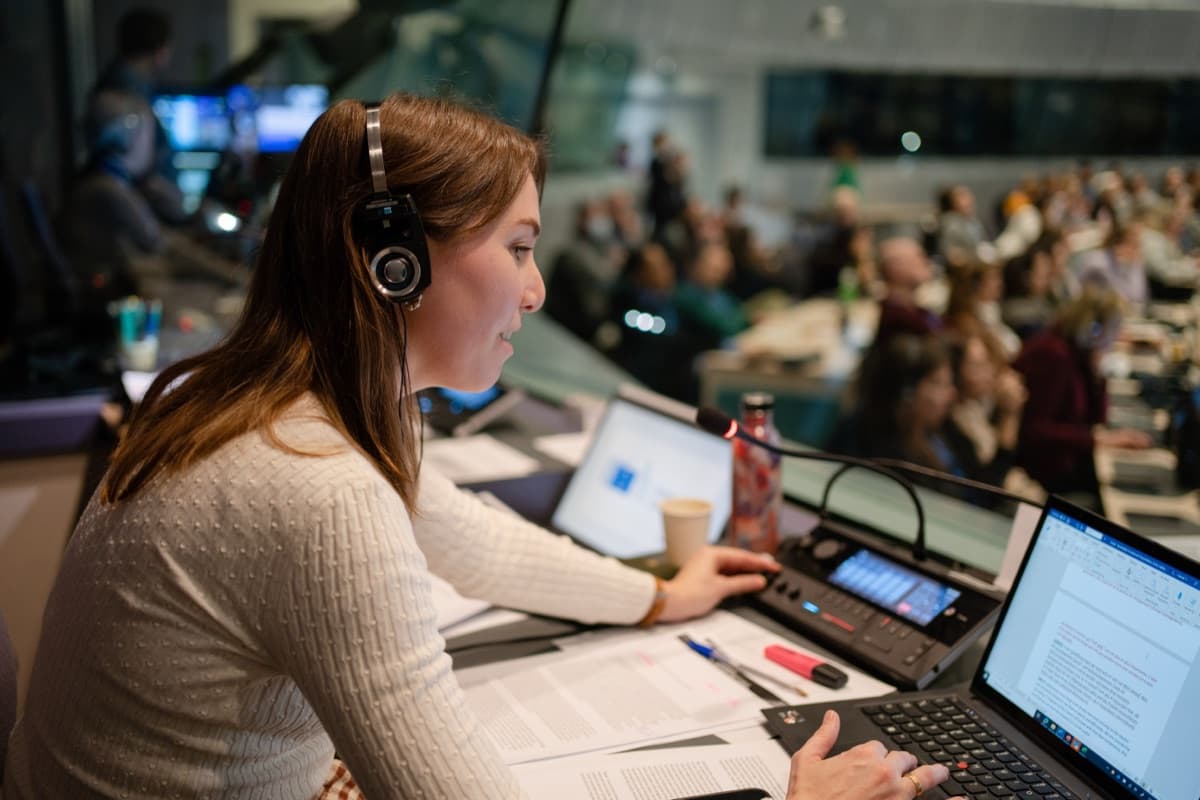
A foreign client arrested at 11 p.m., a medical emergency in a hospital department, an industrial crisis on a production site with Dutch-speaking technicians stuck with a German supplier: the situations that require an emergency interpreter in Belgium are real and varied. In this market segment, availability comes first and rates reflect the constraint of mobilisation outside business hours. This guide describes the real surcharges of the Belgian market, the languages available 24/7, and how to structure a lasting on-call system for your organisation.
What is an emergency interpreting mission?
The notion of emergency in interpreting covers two distinct realities that must be distinguished clearly from the moment of the request.
The first is deadline urgency: a mission requested with less than 24 hours' notice during normal business hours (8 a.m.-8 p.m., Monday to Friday excluding public holidays). In this case, the surcharge reflects the organisational constraint imposed on the interpreter who must reorganise their schedule at very short notice.
The second is time-of-day urgency: a mission beginning or taking place outside standard business hours - evening (8 p.m.-10 p.m.), night (10 p.m.-6 a.m.), weekend (Saturday, Sunday) or Belgian public holidays. This category combines the pressure of the short deadline with the constraint of the time of intervention, and generates the most significant surcharges of the market.
TranslateBE
Interpreter available in an emergency - 7/7, 24/24 in Belgium
Dedicated emergency line, interpreters available at night and on weekends for Arabic, Dutch, English, French and other languages. Immediate quote.
Get a quoteSectors that call on emergency interpreters
Certain activity sectors generate a recurring demand for emergency interpreting in Belgium. Knowing them allows the professionals concerned to anticipate their needs and structure a preventive system rather than managing the panic at 2 a.m.
- Hospitals and medical emergency services: a patient who does not speak French or Dutch arrives at the emergency room. Communication about the symptoms, the medical history and consent to care requires a qualified interpreter, not another patient or a staff member who "makes do" in the language. The large Brussels hospitals (UZ Brussel, CHU Saint-Pierre, Cliniques Saint-Luc, Erasme) manage this need via framework contracts with agencies or VRI subscriptions.
- Police services and prosecutor's offices: an arrest, a police custody, a hearing for a flagrant offence cannot be scheduled. The Salduz law and directive 2010/64/EU guarantee an interpreter to the arrested person, but the police services also call on the private market when their own lists are exhausted.
- Criminal defence law firms: a client arrested abroad, a foreign national placed in pre-trial detention, a call from prison at 9 p.m.: the criminal defence lawyers have regular urgent interpreting needs, often for rare languages (Dari, Tigrinya, Pashto).
- Industrial and logistics companies: a breakdown of equipment operated by an Asian supplier, a safety incident on a site with Polish or Romanian workers, an emergency negotiation with a stuck German client: industrial needs for urgent interpreting are frequent and often underestimated in business continuity plans.
- Insurance companies and claims experts: a serious accident involving foreign nationals, an adversarial appraisal with a foreign expert, a multilingual report on site.
Structure of emergency rate surcharges
The Belgian emergency interpreting market applies structured surcharges according to the nature and time of the mission. These percentages apply to the base hourly rate agreed for the language and the type of mission.
- Deadline of less than 24h on a business day: surcharge of 30 to 50% on the base hourly rate. An interpreter who normally charges 100 euros/hour will be charged between 130 and 150 euros/hour for a mission confirmed in the morning for the afternoon.
- Evening intervention (8 p.m.-10 p.m.): surcharge of 50 to 75%. This time slot often combines the short deadline with the discomfort of the late hour.
- Night intervention (10 p.m.-6 a.m.): surcharge of 75 to 100%. This is the highest rate band of the market. An interpreter available in the middle of the night for Arabic-French can charge between 150 and 300 euros per hour depending on the language and their actual availability.
- Weekend (Saturday and Sunday): surcharge of 75 to 100% depending on the agencies. Saturday is often treated like Sunday in the general terms.
- Belgian public holidays: surcharge of 100%, identical to Sundays. The 10 legal Belgian public holidays (1 January, Easter Monday, 1 May, Ascension, Whit Monday, 21 July, 15 August, 1 and 11 November, 25 December) are all subject to this maximum surcharge.
An important principle: the minimum emergency session is 2 hours, whatever the actual duration of the mission. A police arrest that is resolved in 25 minutes will still be billed on a basis of 2 hours. This rule compensates the mobilisation time and the interpreter's travel.
Availability by language: not all languages are equal at night
24/7 availability is not uniform across languages. On the Belgian market, the languages for which rapid mobilisation (within 1 to 2 hours) is realistic even at night or on weekends are mainly: Arabic (classical Moroccan and dialectal), Dutch, English and French. The community of native speakers in Belgium is large enough to make it possible to find an interpreter available at any hour.
On the other hand, for Tigrinya (Eritrea, Ethiopia), Pashto(Afghanistan), Dari, Somali, Bambaraor LSFB, immediate availability is not guaranteed even in an emergency. The lead time can reach 6 to 12 hours even with an urgent request, and the rates are even higher due to the scarcity of profiles. For these languages, an additional surcharge of 20 to 40% on the standard emergency rates is common.
Table of emergency interpreting rates in Belgium
| Type of service | Indicative rate | Note |
|---|---|---|
| Emergency business hours (less than 4h notice) | 130 - 200 €/h | +30 to 50% vs. standard rate, min. session 2h |
| Emergency evening 8 p.m.-10 p.m. | 150 - 225 €/h | +50 to 75%, min. 2h = 300 - 450 € depending on language |
| Emergency night 10 p.m.-6 a.m. | 175 - 300 €/h | +75 to 100%, min. 2h = 350 - 600 € |
| Emergency weekend (Saturday and Sunday) | 175 - 280 €/h | +75 to 100%, mileage costs extra |
| Emergency Belgian public holiday | 200 - 300 €/h | +100%, applicable to the 10 legal public holidays |
| Emergency rare language at night (Tigrinya, Pashto...) | 250 - 400 €/h | Availability not guaranteed within 6h, scarcity supplement |
Setting up an on-call contract with TranslateBE
For organisations that face recurring needs for urgent interpreting, the most efficient and least costly solution in the long term is to conclude an on-call contract with an interpreting agency. This type of contract defines in advance the conditions of mobilisation, the applicable rates according to the time slots, the priority languages, and the SLA (Service Level Agreement) for response.
A typical on-call contract with TranslateBE may include: a dedicated telephone number reachable 24/7; a commitment to respond within 15 minutes to any urgent request; pre-negotiated stable rates over 12 months, avoiding real-time discussions during a crisis; a dedicated account manager who knows your structure, your frequent languages and your internal procedures; and a monthly report of the missions to facilitate internal billing and budget monitoring.
Clients who have subscribed to such a contract generally benefit from emergency rates 15 to 25% lower than those of the spot market, in exchange for a guaranteed minimum volume or a fixed monthly subscription.
TranslateBE · Certified Agency
Need an interpreter in an emergency? Call us now
Emergency line 24/7. Immediate quote by phone. For recurring needs, ask for our on-call contract offer with pre-negotiated rates.
FAQ
Frequently asked questions
Can I have an interpreter within the hour following my request?
For the common languages in Belgium (Arabic, Dutch, English, French), mobilisation in less than an hour is possible but not guaranteedoutside a pre-established on-call contract. On a business day, the chances of availability are good. At night and on weekends, it depends on the availability of the interpreters registered in our on-call network. The most reliable solution for guaranteed immediate availability is either a VRI subscription (interpreting via video conference), which allows a connection in a few minutes, or an on-call contract with a commitment to on-site availability within 45 to 90 minutes in a defined geographic area. For rare languages, mobilisation within 1 hour remains exceptional even with an on-call contract.
Do emergency rates also apply to common languages?
Yes, emergency surcharges apply to all languages, whether it is Arabic or Japanese. The surcharge is not linked to the rarity of the language but to the constraint of mobilisation outside the deadline or outside business hours. What changes depending on the language is the probability of finding an available interpreter and, for rare languages, a scarcity supplement that is added to the standard hourly surcharges. In practice, for an urgent request in English or Dutch at night, you will more easily find an available interpreter than in Tigrinya, but the hourly surcharge rate applied will be the same. Only the base rate varies depending on the language.
Does my professional insurance cover emergency interpreting costs?
Some professional insurance or business civil-liability policies include clauses covering communication costs in the event of a claim or crisis, which can cover emergency interpreting costs if the need is linked to a covered incident. However, this type of coverage is rare and subject to strict conditions (causal link with the claim, reimbursement ceiling). Check with your broker the specific clauses of your contract. For companies that face regular risks requiring multilingual assistance (international transport, import-export, foreign subcontracting), it is advisable to provision the emergency interpreting costs in the risk-management budget rather than relying on an uncertain insurance reimbursement.
How do I set up an on-call contract for my company?
Setting up an on-call contract begins with an audit of your needs: which languages do you use most often in an emergency, what are the time slots to cover, what estimated monthly volume, and what is your geographic intervention area (Brussels only, all of Belgium, travel abroad). On this basis, TranslateBE offers you a tailored contract with pre-negotiated rates, a dedicated emergency number and an SLA for mobilisation adapted to your constraints. The contract can be structured as a monthly subscription (for predictable volumes) or as a framework agreement on consumption (for irregular needs). Contact us for a qualification appointment, with no commitment, to evaluate the solution best suited to your organisation.