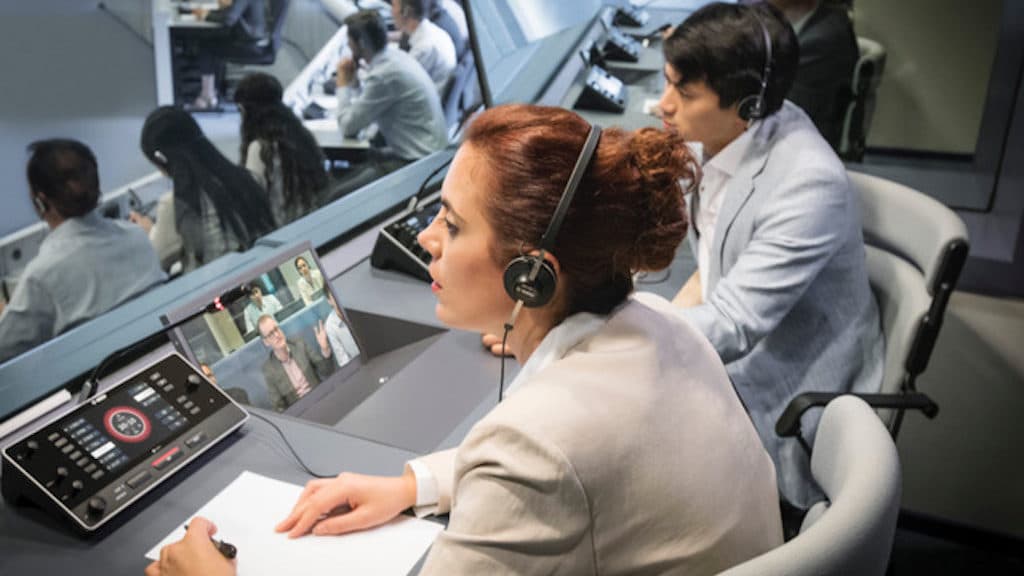
Municipal administrations, federal public services, CPAS/OCMW social services, Fedasil, courts, police - the Belgian public sector is in permanent contact with foreign-language citizens and international delegations. Interpreting in public services is not a convenience: it is an ethical obligation and, frequently, a legal requirement stemming from fundamental rights guaranteed by the Belgian Constitution and international conventions.
The Belgian public sector facing the multilingual challenge
Belgium is a constitutionally trilingual country (French, Dutch, German) to which must be added the languages of approximately 1.5 million foreign nationals residing on its territory. The Belgian public administration thus faces a permanent challenge: providing accessible and equitable services to all citizens regardless of their mother tongue.
The right to an interpreter is a fundamental right guaranteed by several key texts. The European Convention on Human Rights (ECHR), Article 6, stipulates that everyone has the right to the free assistance of an interpreter in judicial proceedings. The Istanbul Convention on violence against women imposes interpreting guarantees for victims. Directive 2010/64/EU on the right to interpretation in criminal proceedings applies directly in Belgian law. These obligations do not stop at the doors of courtrooms: they extend to police interviews, administrative hearings and many procedures before public authorities.
Absolute neutrality and impartiality from the interpreter are imperatives in the public sector. Unlike other sectors where the interpreter may take communicative initiatives, in the public sector they must strictly limit themselves to faithfully conveying the statements of all parties. They may not express an opinion, reformulate beyond what is necessary for comprehension, or maintain personal relationships with any party. These requirements are even stricter during police interviews, hearings as a suspect or judicial proceedings where defence rights are at stake.
TranslateBE provides interpreters trained in the specific requirements of the Belgian public sector, with knowledge of administrative, judicial and police procedures, a strict confidentiality commitment and contractually guaranteed neutrality.
Use cases: interpreting in the Belgian public sector
- Municipal administration reception : counter interpreting for civil registration procedures (marriage, birth, death declaration), planning permit applications, population register enrolments and administrative document requests
- CPAS/OCMW and social services : interpreting during social assistance applications, integration income requests, debt mediation and social support for vulnerable individuals
- Fedasil and asylum seeker reception centres : interpreting during registration interviews, Dublin procedures, international protection applications and social and health support for residents
- Federal public service inspections (Labour, Finance, Health) : interpreting during labour inspectorate checks in companies, tax administration audits and sanitary inspections in care establishments
- Police investigations and prosecution : interpreting during detention hearings, witness, complainant or suspect interviews, judicial investigations and instruction measures within criminal proceedings
- Judicial hearings : interpreting before the Labour Tribunal, the Council for Alien Law Litigation (CCE/RvV), the Council of State, civil, criminal and family courts for foreign-language parties and witnesses
- Foreign delegations and inter-municipal cooperation : interpreting during visits by foreign delegations, cooperation agreements between Belgian and foreign municipalities, and twinning or development cooperation programmes
- Belgian-foreign inter-governmental meetings : simultaneous or consecutive interpreting during bilateral meetings between Belgian authorities and foreign governments on subjects such as security, immigration, economic cooperation or development aid
TranslateBE
Public sector interpreter in Belgium
Our interpreters know Belgian administrative, judicial and police procedures. Neutrality and impartiality guaranteed. Public procurement, CPAS/OCMW, police, courts. Quote within 1 hour.
Recommended interpreting mode
- Liaison interpreting : the standard mode for administrative counters, individual CPAS/OCMW meetings, civil registration matters and Fedasil social interviews: the interpreter facilitates face-to-face conversation
- Consecutive interpreting : appropriate for judicial hearings, police interviews, formal inspections and official meetings: precise and complete rendering of each statement
- Simultaneous interpreting : reserved for large inter-governmental meetings, diplomatic conferences and events involving multiple national delegations simultaneously
- Telephone interpreting : the preferred solution for emergency duty services (24/7 social services, night police stations), rapid interventions and regions with limited field interpreter availability
Indicative rates
| Service | Duration | Indicative rate |
|---|---|---|
| Administrative counter / social interview (liaison) | Half day | 250-400 EUR |
| Judicial hearing / police interview | Full day | 450-700 EUR |
| Public procurement (preferential rates) | Variable | On request |
| Travel | Per km | +0.40 EUR/km |
FAQ
Frequently asked questions
Can the public sector use a private interpreting agency (public procurement)?
Yes. Belgian public institutions - municipalities, CPAS/OCMW, federal public services, police zones, courts - can perfectly engage a private interpreting agency through a public procurement procedure. TranslateBE has experience with public procurement procedures (negotiated procedures, calls for tender) and can provide all required documents: certificate of good standing, references, liability insurance policies, sub-contracting agreements. We offer specific rates for framework contracts with public authorities. Contact us to discuss your needs.
Which languages are most in demand in Belgian public administrations?
The most requested languages in Belgian public services are Arabic (Moroccan, Algerian, Iraqi, Syrian dialects), Romanian, Polish, Dari and Pashto (Afghanistan), Tigrinya (Eritrea and Ethiopia) and Turkish. There is also significant demand for Sub-Saharan African languages: Lingala, Swahili, Wolof, Bambara. Demand varies by region: Antwerp has a large Arabic-speaking and Turkish community, Liege has many English-speaking Africans, and Brussels presents a very diverse profile. TranslateBE covers over 60 languages for the public sector.
How are neutrality and impartiality guaranteed for interpreters in the public sector?
The public sector interpreter must observe strict professional ethics: faithful rendering without omission or addition, no taking of positions, no personal relationships with parties, absolute respect for professional secrecy and GDPR. At TranslateBE, all our interpreters sign a specific professional code of conduct for the public sector before each assignment. They are also sensitised to cultural biases and the management of tense situations (conflictual interviews, people in distress). In the event of a potential conflict of interest, the interpreter is required to declare it and may be replaced.
Is it possible to have an interpreter for police interviews during custody or questioning?
Yes, and this is a fundamental right guaranteed by European Directive 2010/64/EU, transposed into Belgian law. Any person questioned as a suspect has the right to be assisted by an interpreter during custody and questioning. TranslateBE can provide interpreters for police interviews and custody situations, including on an urgent basis for common languages. The interpreter must be qualified, neutral and faithfully record statements without interpreting or reformulating them. Contact us directly by telephone for urgent requests.
Public sector interpreter in Belgium - available quickly
Municipal services, CPAS/OCMW, Fedasil, police, courts: our interpreters cover all Belgian public services with guaranteed neutrality and impartiality. Urgent assignments accepted.