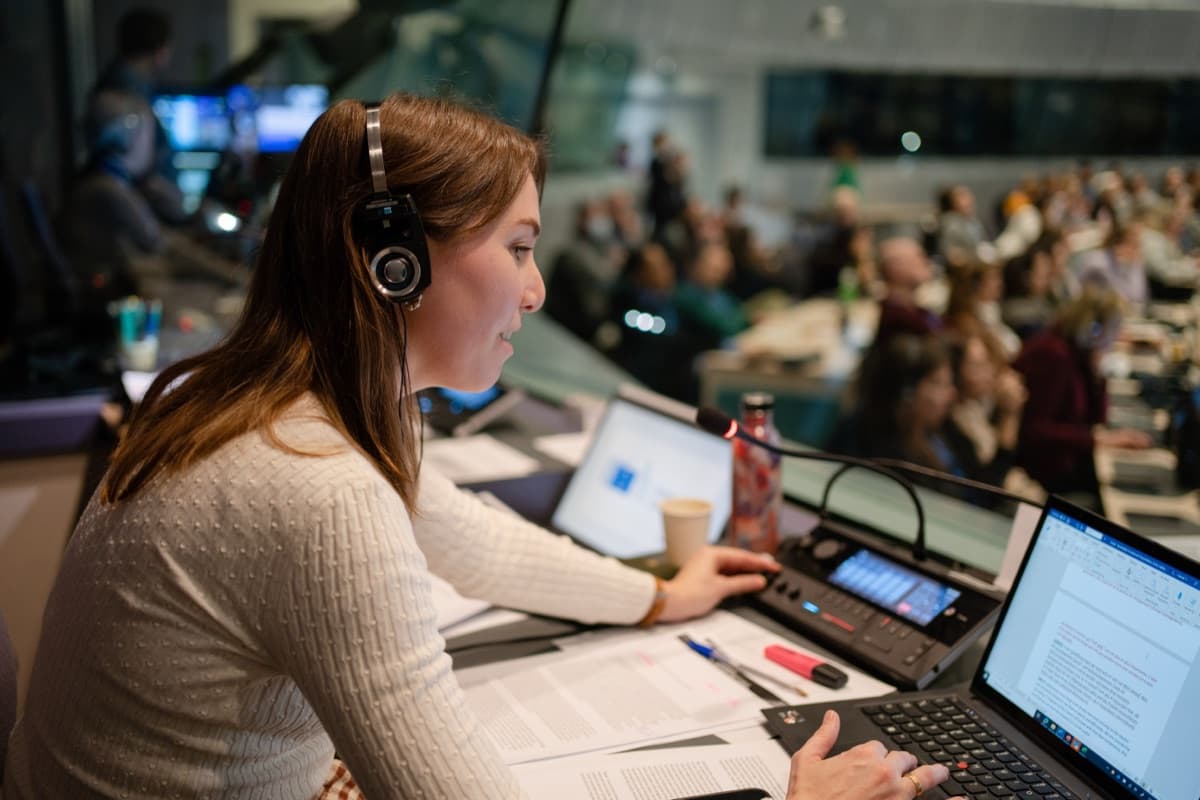
Brussels is the de facto capital of Europe - hosting the EU institutions, NATO headquarters, over 180 embassies and the largest concentration of international organisations outside New York and Geneva. Diplomatic interpreting in Brussels requires interpreters of exceptional calibre: professionals who master the conventions of protocol, the precision of institutional language, and the stakes of high-level multilateral engagement.
The diplomatic interpreting landscape in Brussels
No city in the world outside New York or Geneva hosts as high a density of multilateral diplomatic activity as Brussels. The European Council, the Council of the EU, the European Commission, the European Parliament, the European External Action Service and NATO collectively generate thousands of high-level meetings per year, ranging from heads of state summits to technical working group sessions. Alongside the EU institutional machinery, Brussels hosts the permanent missions of all 193 UN member states, the secretariats of dozens of international organisations, and the headquarters of major global trade associations and lobbying organisations.
This extraordinary concentration creates a uniquely demanding interpreting environment. Diplomatic interpreters in Brussels must be capable of handling the precise, often deliberately calibrated language of political compromise - where a single word in a communiqué can carry enormous legal and political weight, and where a misinterpretation can derail a negotiation or create a diplomatic incident.
EU institutional diplomatic interpreting in Brussels
The EU institutions operate the world's largest interpreting service. The European Parliament's Directorate-General for Interpretation and the European Commission's Directorate-General for Interpretation (SCIC) collectively employ hundreds of staff interpreters and engage thousands of freelance conference interpreters per year. However, many events - bilateral meetings between member state delegations, side meetings during summits, informal working sessions, pre-negotiation consultations and ambassadorial briefings - are not covered by the institutions' in-house services and require external diplomatic interpreters.
TranslateBE
Diplomatic interpreters for Brussels EU and NATO meetings
We provide high-calibre diplomatic interpreters for EU institutional meetings, NATO engagements, embassy events and intergovernmental consultations in Brussels - covering FR-EN-DE-NL-ES and beyond.
NATO diplomatic interpreting in Brussels
NATO's headquarters at Evere hosts political and military meetings in English and French - the Alliance's two official working languages. However, national delegations to NATO committees frequently require interpreting into and from German, Dutch, Spanish, Italian, Polish, Turkish and other Alliance languages for national-level consultations, briefings and bilateral meetings. Our interpreters with NATO experience are familiar with the Alliance's institutional structure, procedural conventions and the specific vocabulary of defence policy, collective security and crisis management.
Embassy and protocol interpreting in Brussels
Brussels' 180-plus embassies and permanent missions organise a continuous programme of bilateral meetings, national day receptions, diplomatic briefings and high-level visits. Diplomatic interpreters for these events must combine language mastery with a thorough understanding of the protocol conventions governing each national diplomatic tradition. Our interpreters for Brussels embassy events are briefed on the specific bilateral relationship, the context of the meeting and the protocol expectations of the relevant mission before each assignment.
FAQ
Frequently asked questions
Do you provide interpreters accredited by the EU institutions for Brussels meetings?
We provide interpreters who hold or have held accreditation from EU institutions, including those who have passed the European Parliament's competitive examinations for freelance conference interpreters (ACI-R, formerly ASP) and those who have worked as freelancers for the European Commission SCIC. These interpreters meet the highest professional standards for EU institutional interpreting. For your specific event and language combination, please contact us to confirm the available EU-accredited interpreters.
How do diplomatic interpreters maintain confidentiality for sensitive Brussels meetings?
All our diplomatic interpreters are bound by a comprehensive confidentiality agreement covering the content of meetings, the identities of participants and any preparatory documents. Beyond contractual obligations, professional interpreters adhere to the strict code of ethics of the International Association of Conference Interpreters (AIIC), which mandates absolute confidentiality. We do not disclose the names of our diplomatic clients, the content of assignments or the identities of participants to any third party under any circumstances.
What language pairs do you cover for diplomatic interpreting in Brussels?
We cover all EU official languages for diplomatic interpreting in Brussels, with particular depth in French, English, Dutch, German and Spanish. We also cover Arabic, Turkish, Russian and Chinese for bilateral meetings involving non-EU diplomatic missions. For rare or very specific language combinations, please contact us with advance notice so we can identify the most qualified interpreter available in our network.