Choosing between consecutive and simultaneous interpreting is one of the most consequential decisions when planning a multilingual event. The two modes serve different needs, have different cost structures and require entirely different technical setups. This guide explains the differences clearly so you can make the right choice for your meeting, conference or legal proceeding.
How consecutive interpreting works
In consecutive interpreting, the speaker delivers a passage of two to five minutes while the interpreter listens and takes specialised notes. When the speaker pauses, the interpreter renders the full content in the target language. The process then alternates: speaker speaks, interpreter interprets. No technical equipment is needed beyond the interpreter's skill and their notepad.
Because of this alternating rhythm, a meeting conducted in consecutive mode takes approximately twice as long as it would in a single language. A two-hour agenda becomes a four-hour session. The upside is that no room preparation, booth installation or wireless equipment is required - consecutive interpreting can begin anywhere, from a boardroom to a courtroom, the moment the interpreter arrives.
How simultaneous interpreting works
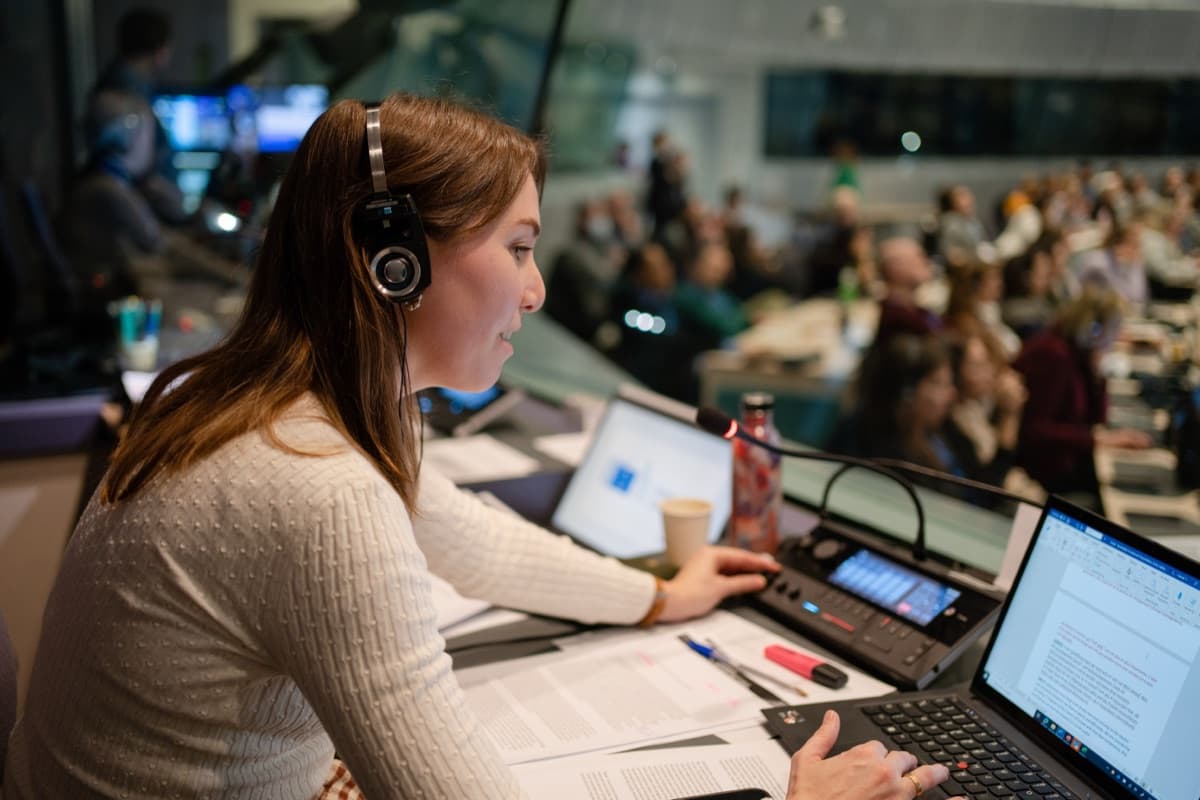
In simultaneous interpreting, the interpreter works in real time while the speaker is still speaking, with a processing delay of only a few seconds. Interpreters work inside soundproofed ISO 4043 booths - typically in pairs, alternating every 20 to 30 minutes due to the extreme cognitive demands of the mode. Delegates receive the interpretation through wireless headsets and listen without any interruption to the flow of the conference.
Simultaneous interpreting preserves the natural pace of the event and allows multiple language pairs to run in parallel. A conference with six working languages can run with six teams of interpreters simultaneously, each serving their respective language audience - a logistical achievement impossible in consecutive mode.
When to choose consecutive interpreting
- Meetings with fewer than 20 participants.
- Sessions involving only two or three languages.
- Legal proceedings - court hearings, depositions, notarial acts - where consecutive is the legal norm.
- Diplomatic bilateral meetings where the conversational quality of consecutive mode is preferred.
- Events where no booth infrastructure is available or budget does not allow for equipment hire.
- Negotiations, press conferences and Q&A sessions where short turns are naturally suited to consecutive delivery.
TranslateBE
Not sure which interpreting mode you need?
Our team will assess your event format and advise you on the most appropriate and cost-effective interpreting solution - consecutive, simultaneous or a hybrid of both.
When to choose simultaneous interpreting
- Large conferences and congresses with audiences of 30 or more participants.
- Events with four or more language pairs where consecutive interpreting would fragment the programme intolerably.
- Keynote presentations, plenary sessions and full-day conference programmes.
- EU institutional meetings and international organisation events where simultaneous is the professional standard.
- Events where preserving the natural pace of speakers and presentations is essential to the participant experience.
Cost comparison: consecutive vs simultaneous
Consecutive interpreting is significantly less expensive than simultaneous for small meetings, because it requires only one or two interpreters per language pair and no equipment. For a two-language bilateral meeting of half a day, a single consecutive interpreter may cost 350-550 €. The same meeting conducted simultaneously would require two interpreters per language pair, ISO 4043 booths, receiver units and a technical operator - a minimum total cost of 2,500 €. For small meetings, consecutive is almost always the economically rational choice.
For large conferences, the economics reverse. Extending a full-day conference to double its duration because of consecutive interpreting imposes enormous costs in room hire, catering, speaker fees and delegate time. Simultaneous interpreting, despite its higher direct cost, is the more efficient solution for events of scale.
FAQ
Frequently asked questions
Can a conference use both consecutive and simultaneous interpreting at different points?
Yes. Hybrid programmes are common. A conference might use simultaneous interpreting for the main plenary sessions and consecutive interpreting for smaller breakout roundtables, bilateral meetings on the sidelines, or press briefings. We can design and staff a comprehensive interpreting plan covering multiple modes across a multi-day conference programme. Contact us with your event schedule and we will propose the optimal configuration.
Is there a minimum duration for booking consecutive or simultaneous interpreters?
For consecutive interpreting, we quote by the half-day (up to four hours), even for sessions that run shorter. This reflects the interpreter's preparation time, travel and the commitment of the full block of their professional schedule. For simultaneous interpreting, the minimum booking includes the equipment hire and at least one half-day of interpreting. Contact us with your specific duration and we will provide a clear and transparent quote.
Which mode is used for international arbitration hearings?
International arbitration hearings commonly use a combination of both modes. Opening statements and procedural arguments may be delivered in consecutive mode, while witness examinations and expert testimony - where sustained, long-form content must be interpreted efficiently - may use simultaneous interpreting with portable equipment. The choice depends on the arbitral tribunal's preferences and the parties' agreement. We can advise on the interpreting provisions for your specific arbitration proceeding.