Belgium's role as host to the EU institutions, NATO headquarters and one of Europe's busiest seaports makes it one of the highest-demand markets for business interpreting on the continent. This guide covers the main sectors, languages and practical considerations for professional interpreting across Belgium.
Why Belgium generates such high demand for business interpreting
Belgium is officially trilingual - French, Dutch and German - with English functioning as a de facto fourth business language. This linguistic complexity is unique in Europe and creates a constant need for professional interpreters in corporate, institutional and legal settings. Companies based in Flanders regularly negotiate with Walloon counterparts, Belgian firms engage with German and French trading partners, and international organisations headquartered in Brussels conduct meetings in four or more languages simultaneously.
The country's main economic sectors each generate distinct interpreting needs. The Port of Antwerp-Bruges produces intensive demand for Dutch, English, German, French and Asian language interpreting. The pharmaceutical cluster (Janssen, UCB, GSK) requires high-level scientific interpreting for clinical, regulatory and commercial meetings. The financial sector in Brussels and Luxembourg demands precision in French, English, Dutch and German for negotiations, board meetings and regulatory hearings.
Interpreting formats for Belgian business settings
Consecutive interpreting remains the most common format for bilateral and trilateral meetings. The interpreter listens to a complete statement, takes notes and delivers the rendition in the target language. Delivery is sequential, which naturally extends the duration of the meeting but allows for high accuracy and nuance - essential for contract negotiations or dispute resolution sessions.
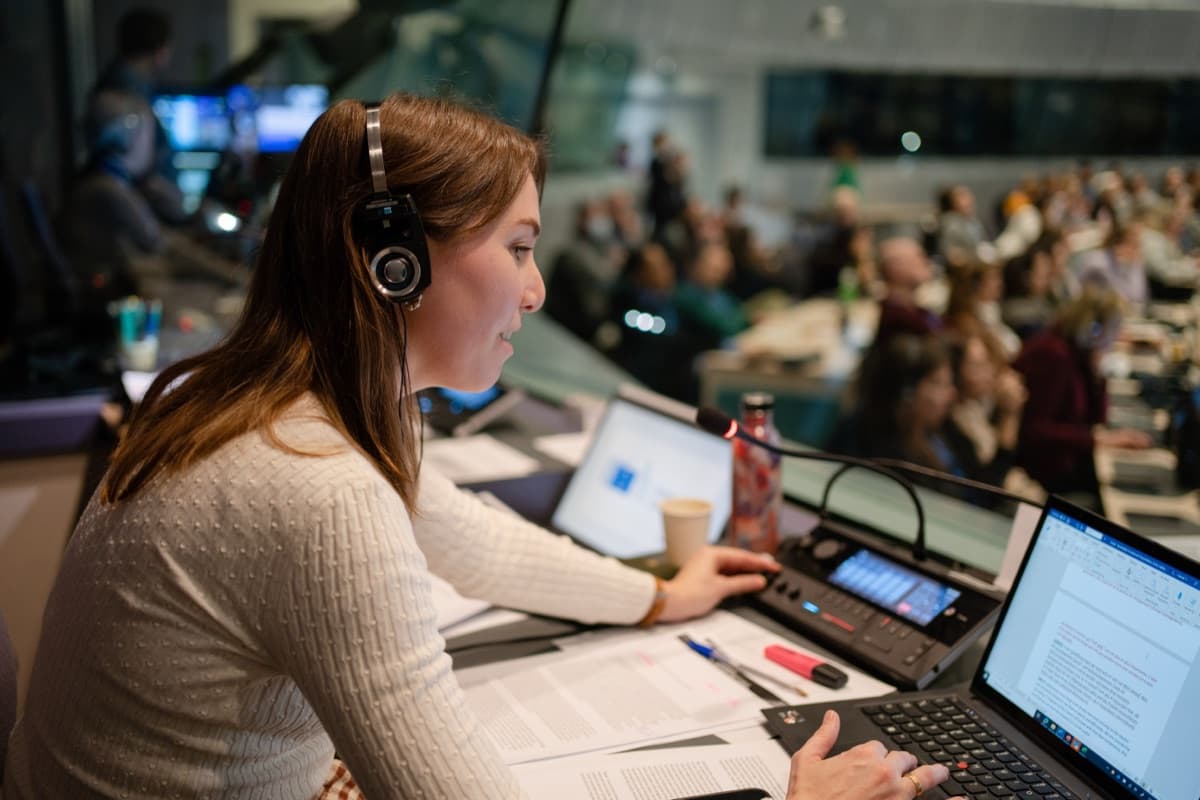
Simultaneous interpretingis standard for larger events: shareholders' general assemblies, trade association congresses, international conferences at Brussels or Antwerp convention centres. Interpreters work in soundproof booths in pairs, switching every 20 to 30 minutes to maintain concentration. Delegate receivers and transmitters complete the technical setup.
Liaison and escort interpreting is widely used for trade delegations, factory visits and procurement missions. The interpreter accompanies the delegation throughout the day, interpreting consecutively in an informal, fluid manner.
TranslateBE
Professional business interpreting across Belgium
NL-FR-EN-DE and 70+ languages. Consecutive, simultaneous and liaison interpreting for Belgian companies and institutions.
Rates, availability and how to book
Business interpreting in Belgium is typically charged by the half-day (up to four hours) or full day (up to eight hours), plus travel and preparation time for specialised assignments. For simultaneous interpreting, equipment rental and a second interpreter are factored into the quote. Rates vary according to the language pair, the technical complexity of the subject matter and the required notice period.
TranslateBE operates 7 days a week and can confirm interpreter availability for most language pairs within a few hours of receiving your request. For last-minute assignments (less than 24 hours' notice), a surcharge applies. We cover all Belgian cities - Brussels, Antwerp, Ghent, Liège, Bruges, Leuven, Namur, Mons and more - as well as cross-border missions in the Grand Region.
FAQ
Frequently asked questions
Is business interpreting in Belgium different from conference interpreting?
Business interpreting typically refers to interpreting in a corporate or commercial context - negotiations, meetings, audits, training sessions - as opposed to large public conferences. The formats overlap (consecutive and simultaneous are used in both), but business interpreting usually involves smaller groups, greater confidentiality requirements and more sector-specific terminology.
Which languages are most in demand for business interpreting in Belgium?
Dutch, French, English and German account for the vast majority of requests. Spanish, Italian, Mandarin, Japanese and Arabic are frequently requested for trade and investment missions. We also cover less common business languages such as Polish, Romanian, Turkish and Korean on request.
Do interpreters sign an NDA for sensitive corporate assignments?
All TranslateBE interpreters sign a standard confidentiality agreement as part of their engagement with us. For M&A negotiations, regulatory investigations or particularly sensitive board discussions, we can provide a bespoke NDA tailored to your requirements before the interpreter is briefed.